





On 2 November 2026, the Securities and Futures Commission (SFC) published its first Large Firm AI Readiness Survey. It covered 20 large financial firms and 78 affiliated licensed corporations, together accounting for over 75% of reported securities transaction turnover for the six months ended 30 June 2026.
AI is becoming embedded in internal systems and workflows. As applications gain access and autonomy, governance needs to cover the whole process: data sources, permitted actions, downstream decisions and effective human intervention.
KEY SURVEY INDICATORS
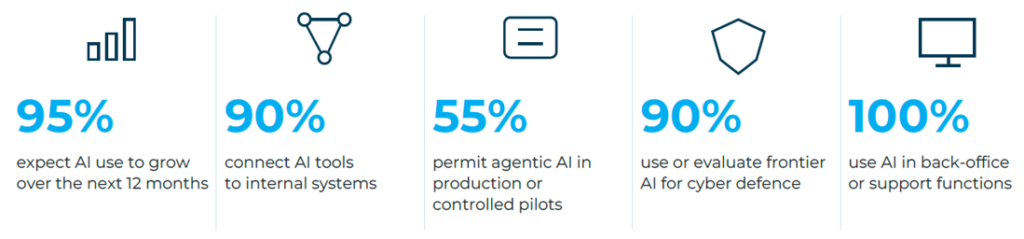
Source: SFC Large Firm AI Readiness Survey, 2 November 2026. Percentages relate to 20 consolidated firm responses. Practices are self-reported, not independently validated, and are not representative of all licensed corporations. Each firm accounts for five percentage points.
WHAT THIS MEANS FOR COMPLIANCE
The survey signals supervisory priorities. It does not introduce a standalone AI licensing regime. Existing requirements continue to apply. The SFC emphasises investor protection, cybersecurity and resilience, AI governance and collaboration. Controls should be proportionate to an application’s authority and potential impact.
OUR PERSPECTIVE
A policy alone cannot demonstrate that AI is properly governed. Management should be able to show who owns each material application, what it may access and do, how its outputs affect regulated activities, and how staff can challenge or stop it. These are business and compliance decisions, not just technology ones.
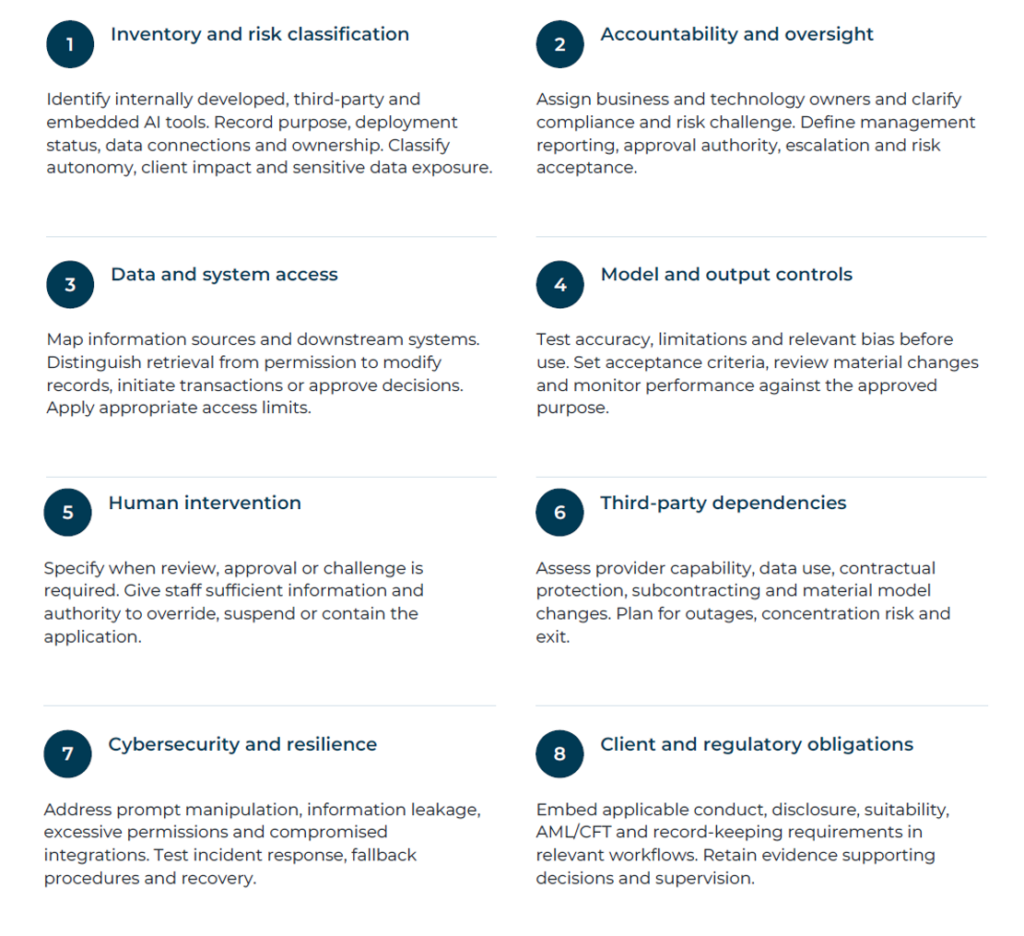
CONTROL PRIORITIES ACROSS THE AI LIFECYCLE
The review should follow each AI workflow from approval through deployment, monitoring, change and retirement. The practical review areas below can be tailored to a firm’s activities and risk profile.
EXISTING REQUIREMENTS AND EMERGING GUIDANCE
The SFC’s November 2024 circular addresses generative AI language models, while its June 2026 circular addresses AI-enabled cybersecurity threats. At FinTech Week, the SFC indicated plans for principles-based guidance on applications with greater autonomy. The survey does not itself introduce new binding requirements. The proposed guidance has not yet been issued, and existing applicable requirements continue to apply.
The 2024 circular sets out four core principles: senior management responsibility, model risk, cybersecurity and data risk, and third-party risk. Where high-risk use such as investment advice or research represents a significant change in the nature of a firm’s business or its services, it must be notified to the SFC under the Securities and Futures (Licensing and Registration) (Information) Rules. The SFC also plans a cybersecurity framework with baseline and enhanced requirements.
Sources: SFC Large Firm AI Readiness Survey and related announcement (2 November 2026), Use of Generative AI Language Models Circular (12 November 2024), AI-enabled cyberattacks circular (2 June 2026), FinTech Week panel remarks (2 November 2026).
OUR PERSPECTIVE ON PROPORTIONATE OVERSIGHT
Human accountability does not require manual approval of every AI output. Oversight should reflect the consequences of the action, the authority delegated to the application and the evidence needed by management to maintain effective oversight. Specific human-review requirements for high-risk use cases under the SFC’s November 2024 circular continue to apply.
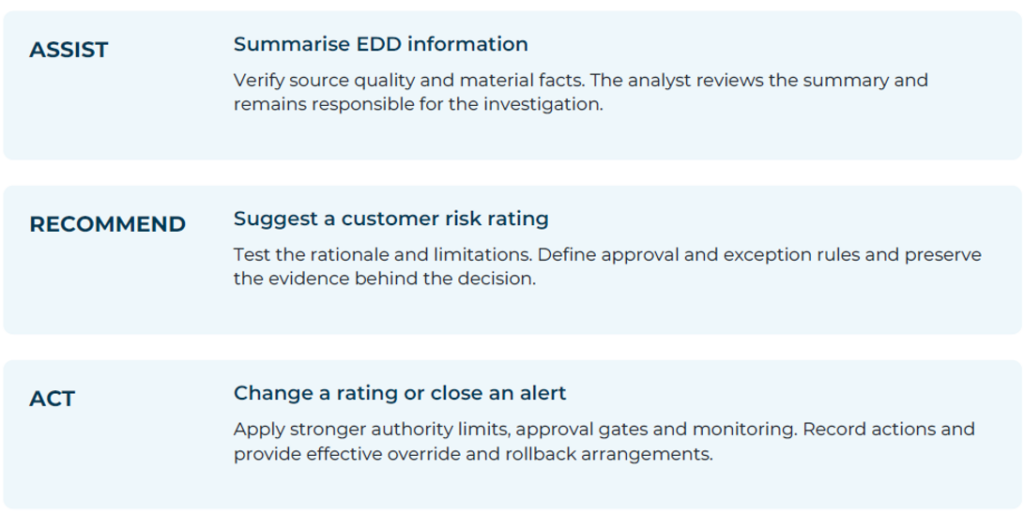
Illustrative examples only. Whether an application is acceptable depends on the relevant activities, controls and applicable requirements. The survey does not validate any particular AI model or workflow.
WHAT MANAGEMENT SHOULD DO NEXT
Prioritise applications that touch client information, regulated decisions or transaction systems. Test realistic failures and document how the firm detects, challenges and contains them. Control evidence should show what happened in practice, rather than only what a policy requires.
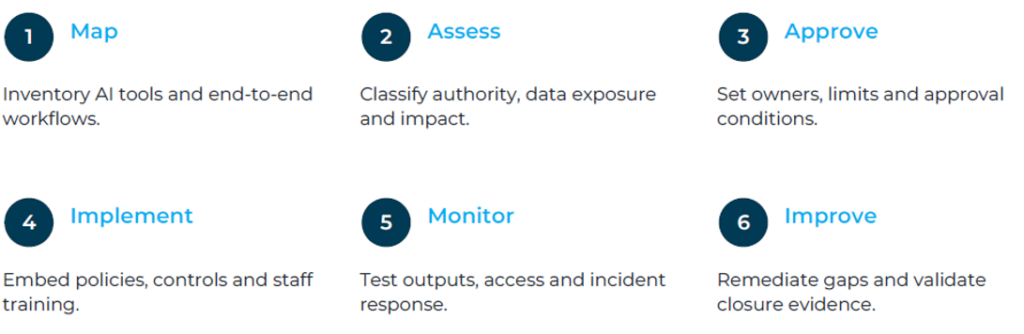
A useful management question is whether the firm can reconstruct an AI-supported decision: the source information used, the action permitted, the review performed and the person accountable.
Source: SFC circular on generative AI language models (12 November 2024).
HOW MOORE HONG KONG CAN ASSIST
Our Advisory Services team can help translate applicable requirements and supervisory expectations into practical governance, controls and review evidence. Engagements can be tailored to a firm’s AI use cases, business model and stage of adoption.
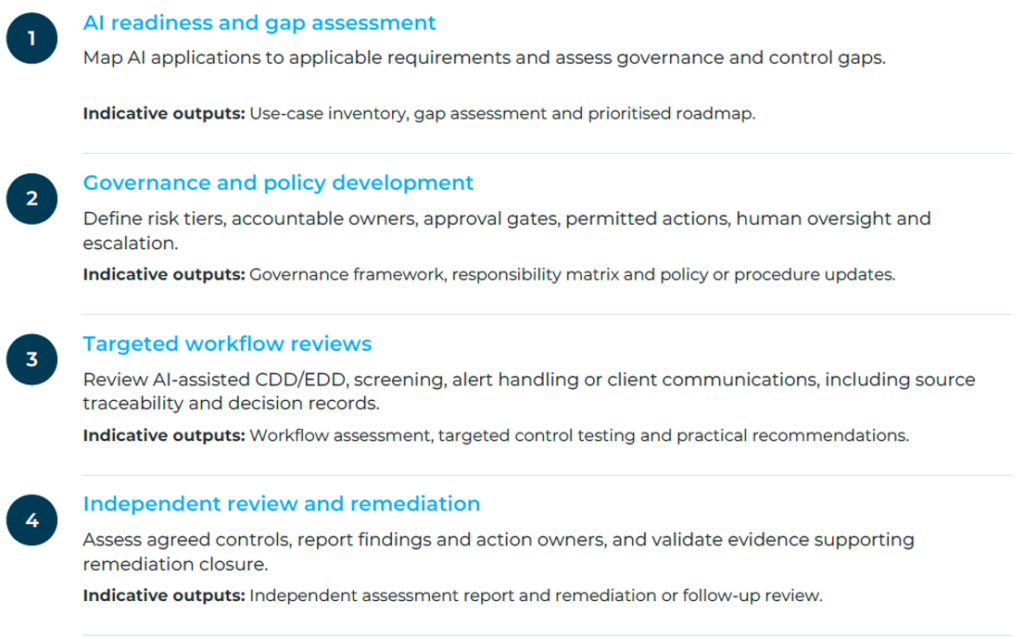
Technology, model validation and cybersecurity work would be separately scoped with appropriately qualified specialists. Management retains responsibility for compliance and decisions on AI deployment. We can also support management and staff training on AI governance and regulatory risk.
CONTACT OUR ADVISORY TEAM
To discuss the implications for your organisation or a targeted AI governance review, please contact our Transaction Services Managing Director, Kenneth Ma, Advisory Services Directors, Joe Chan, Kevin Lau, or Advisory Services Principal, Nicky Kwok.