





In December 2024, The Stock Exchange of Hong Kong (HKEX) published the conclusions to its review of the Corporate Governance Code (CG Code) and related Listing Rules (LR). The amendments took effect on 1 July 2025 and apply to corporate governance reports and annual reports for financial years commencing on or after that date, which means that for most issuers, the first reporting cycle under the revised CG Code is the one now underway.
The changes are not simply a disclosure exercise – issuers are expected to put in place and evidence new governance practices, including a board skills matrix, a formal board performance review, mandatory director training, and an upgraded board statement on the effectiveness of risk management and internal control systems. Several provisions that were previously “comply or explain” now sit as mandatory disclosure requirements, so the room to defer action has narrowed considerably.
OVERVIEW OF THE ENHANCED FRAMEWORK
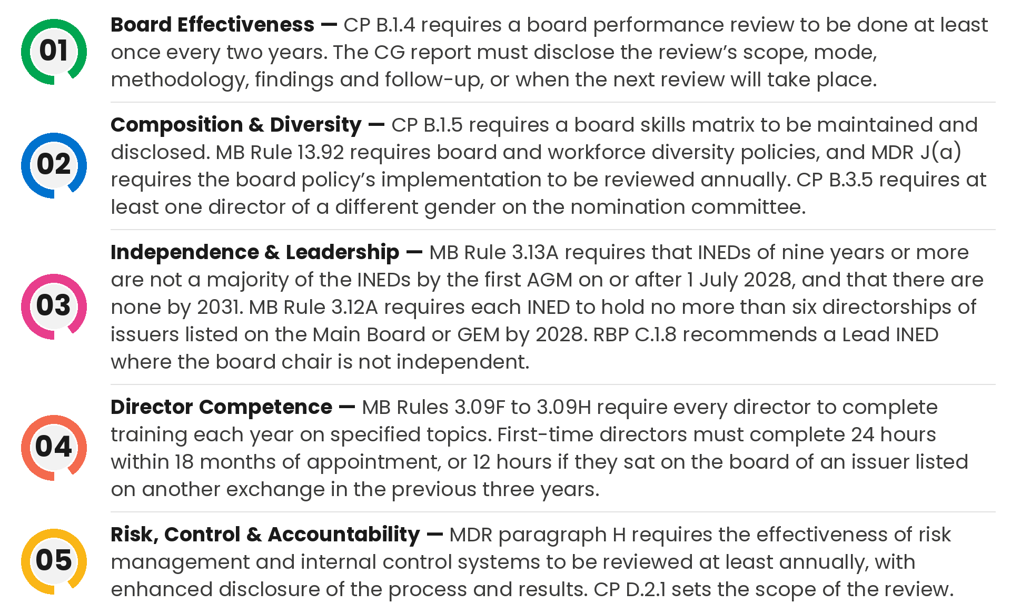
The requirements apply to all Main Board issuers, other than secondary listed overseas issuers, under Chapter 3 and Appendix C1 of the Main Board Listing Rules, with mirror provisions for GEM issuers under Chapter 5 of the GEM Listing Rules. Code Provisions operate on a comply-or-explain basis, but the explanation must be specific to the issuer’s circumstances, and the Listing Rule changes on director training, INED tenure and over boarding are mandatory.
The package introduces two further disclosures that fall outside the board effectiveness theme: dividend policy disclosure under Mandatory Disclosure Requirement M, where an issuer must either set out the aim of its policy and the factors the board weighs, or state that it has none and explain why; and enhanced shareholder engagement disclosure under Mandatory Disclosure Requirement L(d) and Code Provision F.1.1.
WHEN THE REQUIREMENTS TAKE EFFECT
Because the amendments apply by reference to financial years commencing on or after 1 July 2025, the practical deadline differs according to the issuer’s year end:
| Financial year end | First affected financial year | First corporate governance report under the amended Code |
| 30 June | 1 July 2025 – 30 June 2026 | Published with the annual report, by 31 October 2026 |
| 31 December | 1 January 2026 – 31 December 2026 | Published with the annual report, by 30 April 2027 |
| 31 March | 1 April 2026 – 31 March 2027 | Published with the annual report, by 31 July 2027 |
Two of the Listing Rule caps carry longer transitional periods. The limit of six Hong Kong listed issuer directorships for an INED must be met by the first annual general meeting held on or after 1 July 2028³. The nine-year tenure cap is phased over six years: by the first annual general meeting on or after 1 July 2028, long-serving INEDs must not form a majority of the INEDs on the board; by the first annual general meeting on or after 1 July 2031, no long-serving INED may be treated as independent. A three-year cooling-off period applies before a former long-serving INED can be re-designated¹.
Boards that read 2028 and 2031 as distant dates are underestimating the lead time. An issuer with three long-serving INEDs needs a documented skills gap, a succession pipeline, a candidate search and shareholder approval — a sequence that spans more than one annual general meeting cycle, and one that will be competing with every other issuer in the market for the same pool of candidates.
THE BOARD PERFORMANCE REVIEW IN PRACTICE
Under the revised CG Code, new Code Provision B.1.4 requires the board of a listed issuer to conduct a regular evaluation of its performance at least once every two years. The focus is on the overall performance of the board as a whole, not on the assessment of individual directors. New Code Provision B.3.1(e) further requires the nomination committee to support the board’s regular evaluation process.
Where a review was carried out during the reporting period, the corporate governance report should state whether it was conducted internally or by an external party, the methodology and scope adopted, any other relationship between the issuer and an external reviewer, the findings, and the measures taken or planned in response. Where no review was carried out, the issuer should state when the next one will take place².
HKEX’s Corporate Governance Guide sets out the areas a review would ordinarily cover⁴:
- board composition, potential succession plans, and whether the current mix of skills, experience and independence supports the issuer’s strategy;
- board culture, boardroom dynamics and the quality of collective decision-making;
- governance practices and procedures, including the conduct and effectiveness of board and committee meetings;
- the quality, sufficiency and timeliness of information provided to directors;
- regulatory compliance and the adequacy of director training;
- the board’s oversight of risk management and internal control; and
- engagement and communication with shareholders and other stakeholders.
Choosing the Review Mode
An internal review is less costly and draws on institutional knowledge, but a board assessing itself has an evident objectivity problem, and the resulting disclosure tends to read as self-congratulatory. An externally facilitated review brings independence, peer benchmarking and credibility with investors, and HKEX encourages issuers with complex or rapidly changing operations to consider one⁴. For a mid-cap issuer running its first review, a hybrid approach — an internally administered questionnaire followed by externally facilitated director interviews and reporting — is usually the proportionate answer.
What the Review Must Leave Behind
Whatever the mode, the review has to generate an evidence trail: the instrument used, the population of directors covered, the dates on which questionnaires or interviews were completed, the analysis, the report to the board or nomination committee, the minute recording the board’s consideration of it, and an action plan with named owners and target dates. Without that record the disclosure cannot be substantiated, and the review cannot be relied upon in any subsequent regulatory enquiry.
WHERE THE WEAKNESSES ARE LIKELY TO BE
Based on the requirements as drafted, HKEX’s published guidance and our experience of governance and internal control reviews for Hong Kong issuers, the following are the areas most likely to attract scrutiny from regulators, proxy advisers and institutional shareholders:
Process Described while Findings are Withheld
The temptation is to set out the mechanics of the review at length and then conclude that the board “operates effectively” without identifying a single area for improvement. Code Provision B.1.4 requires a formal evaluation of the board as a whole at least every two years and, where a review was conducted in the reporting period, disclosure of how it was done and details of the findings, including significant areas of improvement (if identified) and measures taken or planned. A review that surfaces nothing invites the inference that it asked nothing difficult. A clean bill of health is not by itself a breach, but a process-only write-up with no findings or follow-up measures is a weak disclosure under B.1.4.
Findings Without Owners or Timetables
Where improvement areas are identified, they are frequently left as observations. The disclosure should link each finding to a specific measure, an accountable owner and a timeframe, and the following year’s report should state what was actually done.
A Skills Matrix Disconnected from Succession
Code Provision B.1.5 requires the board skills matrix to be maintained and disclosed. Its value lies in showing where the board is short, and in driving the nomination committee’s succession planning. A matrix in which every director is marked competent in every category demonstrates nothing, and sits awkwardly beside the tenure cap deadlines.
Training Records Reconstructed After the Year End
The Listing Rules now require every director, not only new appointees, to complete training each year on the topics specified in Main Board Rule 3.09G, and the corporate governance report must disclose each director’s hours, topics, delivery mode and provider. Records assembled from memory in the weeks before the annual report are incomplete and difficult to support. A continuously updated register maintained by the company secretary is the only practical answer.
An Internal Control Review Narrower Than the Disclosure Requires
Code Provision D.2.1 now requires an annual review (disclosed under Mandatory Disclosure Requirement H) of the effectiveness of the issuer’s risk management and internal control systems covering all material controls — financial, operational and compliance — across the issuer and its subsidiaries. Reviews confined to financial reporting controls or that omit overseas or newly acquired subsidiaries will be insufficient to support the statement made in the corporate governance report.
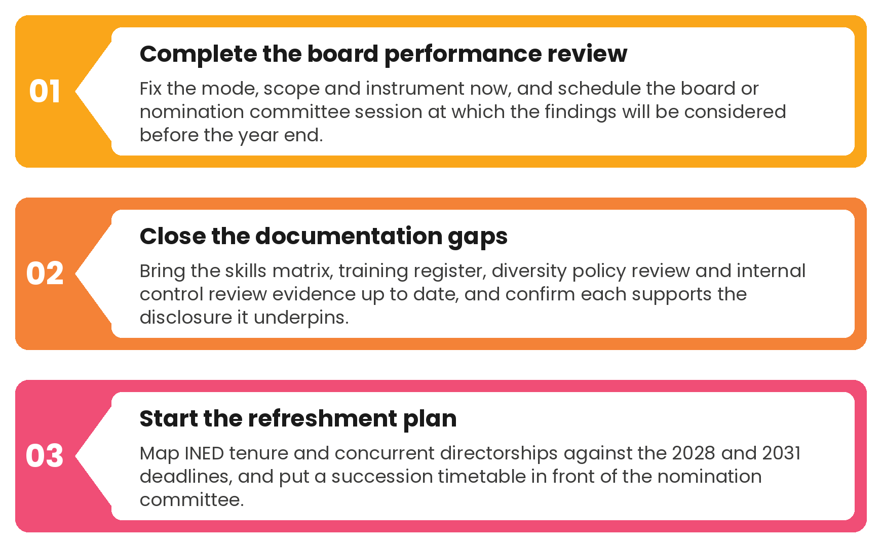
PRIORITY ACTIONS FOR THE REMAINDER OF THE FINANCIAL YEAR
Our Corporate Governance Advisory Services
We offer a tiered, cost-aware approach to the board performance review, so that the exercise fits the board’s size, complexity and budget, together with the related governance and internal control work the amended Code requires.
Full External Review
We design the assessment criteria, gather candid and confidential input from directors and key stakeholders, benchmark the board against peers, and deliver a board-ready report with prioritised, actionable findings.
Externally Facilitated (Hybrid) Review
We design the process and independently assess the findings while your team runs the internal review procedures and logistics — capturing external insight while managing cost.
Internal Review Support
We equip the company secretary and the board with the questionnaires, skills matrix tools and disclosure templates needed to run a robust review in-house, ready to bring us in as requirements grow.
Risk Management and Internal Control Effectiveness Review
Independent review of the design and operating effectiveness of financial, operational and compliance controls across the issuer and its subsidiaries, scoped to support the annual statement required under Mandatory Disclosure Requirement H.
Disclosure and Remediation Support
Across all three review modes of the board performance review, we help translate findings into a corporate governance report disclosure that is compliant, credible and clear, and into a practical roadmap for board refreshment, director training and succession.
Service Track Record
Moore Hong Kong brings a deep governance, internal control and ESG heritage, with a track record advising listed and pre-IPO clients across Hong Kong and Mainland China on internal control, risk management, ESG and corporate governance. Our methodology is built around the Corporate Governance Code and HKEX’s stated expectations, so that findings are implementable and the resulting disclosure stands up to investor and regulator scrutiny. Our bilingual English and Chinese team works across both governance environments.
Conclusion
The amended Code moves the assessment of board effectiveness from a matter of internal judgement by management to a matter of public record. Boards that treat the performance review as a genuine diagnostic with supporting documentation will find the disclosure straightforward, and it will both improve the governance processes of the Company and ensure compliance with HKEX requirements in the years to come.
If you would like to discuss how these changes affect your organisation, please contact our Transaction Services Managing Director, Kenneth Ma, or Advisory Services Director, Joe Chan.