





Intellectual Property (IP) financing, which involves leveraging IP as collateral for debt, equity investment, or other credit facilities, is fundamentally transforming how innovation-driven businesses secure capital. By using intangible assets like patents, trademarks, and copyrights as collateral, companies — especially technology-focused SMEs — can access the funding they need to grow, even without tangible assets. As global markets evolve, Hong Kong is leading efforts to promote IP financing, driving innovation and economic progress through bold, strategic initiatives.
To address this opportunity, the Government proposed a comprehensive strategy in the 2025 Policy Address to strengthen the financing ecosystem.
HONG KONG: IP FINANCING INITIATIVE IN 2025 POLICY ADDRESS
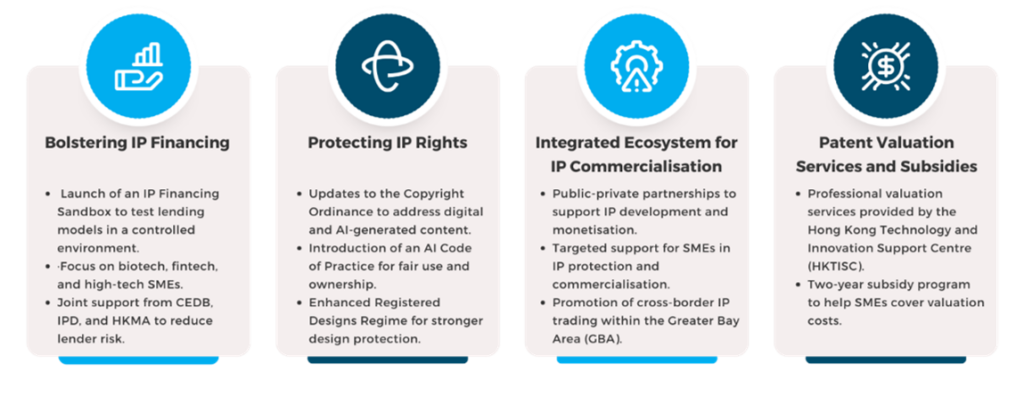
A recent key development is that the IP Financing Sandbox (the “Sandbox”) has been launched in December 2025, a collaboration between the CEDB, the Intellectual Property Department (IPD), and the Hong Kong Monetary Authority (HKMA). This initiative aims to assist pilot sectors in leveraging IP for financing by integrating support from banking and valuation professionals.
As announced, three major banks in Hong Kong have joined the Sandbox as inaugural participants, and have focused on biotechnology, electronics and technology sectors to conduct pilot trials of IP financing through the Sandbox. Furthermore, nearly 30 professional firms from the legal and valuation sectors have indicated keen interest in participating in the Sandbox. It is anticipated that several trial cases are in the pipeline for the first phase of the Sandbox. Besides, the Hong Kong Technology and Innovation Support Centre (HKTISC) also commenced full operations in December 2025 for promoting IP financing. A support scheme through the HKTISC is planned to be launched in 2026 to financially assist SMEs to engage professional service providers for the valuation of their IP.
To facilitate the credit assessment process, the government is finalizing a Patent Valuation Subsidy Pilot Programme (the “Subsidies”). We understand the IPD is working towards a Q3 2026 launch, offering subsidies on a 1:1 matching basis, i.e. the government and the applicant will share the costs equally, with a cap of HK$80,000 per application. While these measures aim to lower the cost of entry for enterprises to obtain financing, the crux for obtaining these funds could be the quality of works of professional valuers: providing robust IP valuations that banks can trust. This article explores these new financing avenues and briefly touches on the valuation methodologies required to unlock them.
THE CORE CHALLENGE: BRIDGING THE “VALUATION CHASM”
Many institutions face challenges in accessing professionals with the combined legal, technical, and financial expertise required for complex IP valuation. Despite the immense value held in IP, traditional banking models favour tangible assets because they are easy to value and liquidate. Intangible assets, by contrast, lack a standard closed-form formula for valuation. This “knowledge gap” makes the future cash flow of a patent opaque to lenders, leading to elevated risk perception and conservative lending limits.
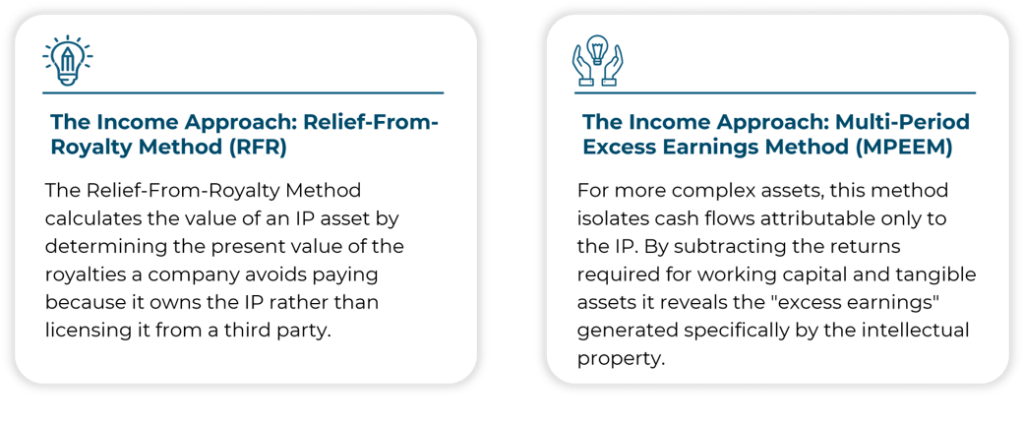
Enterprises and valuers must bridge this gap by applying internationally recognised valuation methods. Among the three common approaches (Income, Cost, and Market), the Income Approach is most relevant for financing decisions, as it forecasts future economic benefits.
A PROVEN MODEL: LESSONS FROM MAINLAND CHINA
As Hong Kong develops its IP financing ecosystem, it draws reference from the mature models already operating in Mainland China. Their experience demonstrates how government policy can successfully unlock capital for technology-driven SMEs.
There are three distinct financing models currently thriving in Mainland China that offer a roadmap for what may develop in Hong Kong:
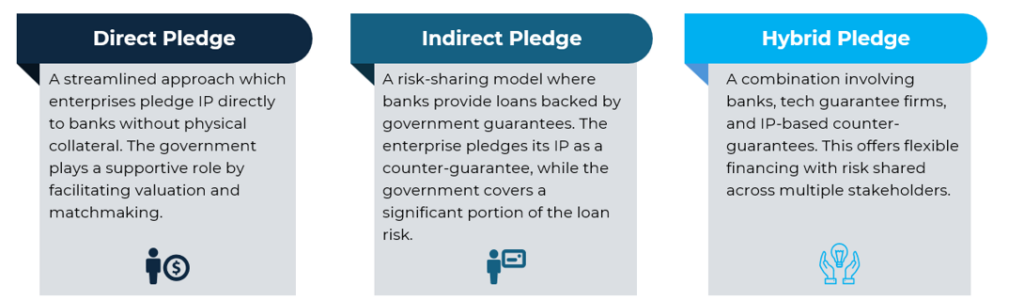
To support these models, regional governments in Mainland China have implemented robust incentives, including interest costs subsidies for prioritized industries like biotech and artificial intelligence, risk compensation funds to share credit losses with lenders, and insurance premium subsidies to make IP loan insurance more affordable. These measures have successfully encouraged banks to lend against intangible assets—a success story Hong Kong aims to replicate with its new Sandbox and Subsidies.
THE INNOVATION IMPERATIVE
Building a collaborative ecosystem between the government, financial institutions, and professionals is critical to the success of IP development. Robust IP financing will unlock growth capital, enabling Hong Kong to become a regional IP trading centre with a robust ecosystem where IP is protected with rigour, valued with clarity, and financed with confidence.
Moore Transaction Services
Moore Hong Kong has been actively providing transaction and valuation advisory services to its clients. We are eager to share our insights on the subject matters in this regard, with our team of valuation specialists and transaction advisory experts, who are holders of professional qualifications including Chartered Financial Analyst (CFA), Financial Risk Manager (FRM), Certified Public Accountant (CPA), member of the Royal Institution of Chartered Surveyors (MRICS), Chartered Alternative Investment Analyst (CAIA) and the Certified ESG Analyst (CESGA) designation granted by the European Federation of Financial Analysts Societies (EFFAS).
Should you wish to know more about Intellectual Property Financing, please WhatsApp +852 6938 9310 or contact our Transaction Services Managing Director, Kenneth Ma, or Transaction Services Principal, Calvin Wong.